Digital marketing
The Essence of a CDP
- CDP
- Digital transformation

Have you been hearing a lot about CDPs lately? Did you find this article while trying to figure out what a CDP actually is?
- CDP vs CRM
- CDP vs DMP
- CDP vs BIG DATA
Comparisons between these terms have become some of the hottest topics in MarTech (marketing technology). But are you still a little foggy on them? Why are so many terms tied to the CDP? Is the CDP just a passing buzzword? Let’s break down the essence of the CDP so you fully understand its past, its present and its promising future.
Tesla’s Elon Musk is famous for his productivity. One of his principles for working efficiently is to reason from “first principles,” which means getting to the essence of the work itself. Exploring the essence of the CDP means finding its first principles. Once you grasp the core concept of a CDP, you can correctly judge where it applies and the value it can deliver.
MarTech (marketing technology) is evolving faster than any other area of application software. It’s often said that a marketing technology term people have only just become familiar with is already a system you need in order to compete. To gain a new competitive edge in marketing technology, you need more market observation and hands-on practice to get the timing of system and technology adoption right and keep your business competitive.
Most application systems consist of a user interface (UI) plus a database (DB), and many of the applications in a modern enterprise follow this structure, such as ERP, workflow forms and EIP. Customer-facing applications include telemarketing, customer service and CRM. These common enterprise applications all share this combination.
The CDP is no exception: it is also a system made of a user interface plus a database.
And every enterprise application exists to “solve a problem”:
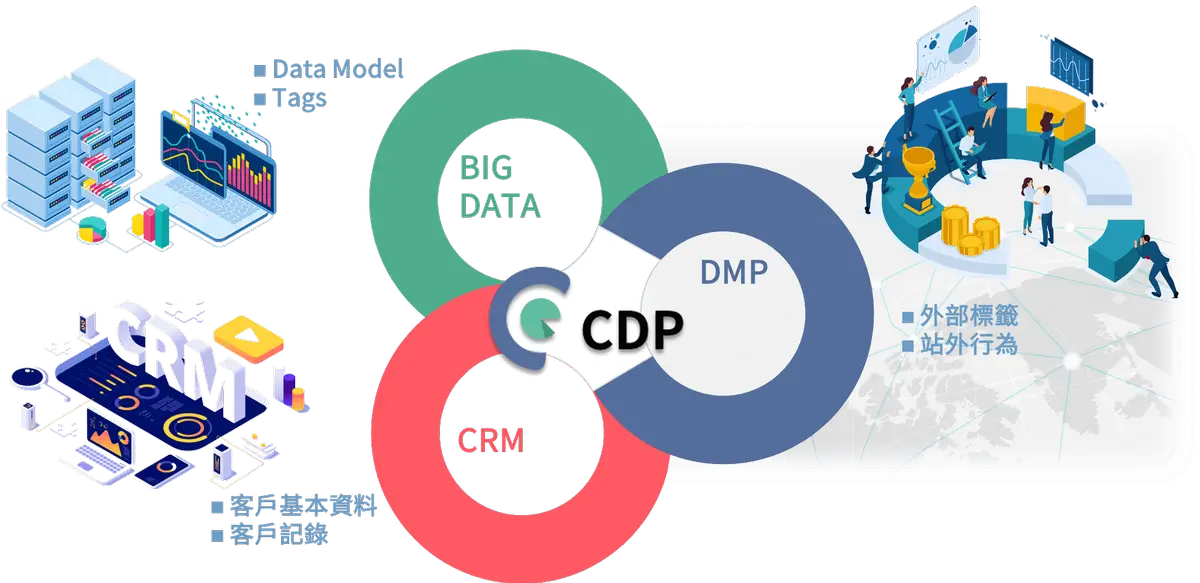
- BIG Data solves the problem of data scattered across the company that can’t be effectively combined, whether batch or real-time. Integrating data, producing cross-platform reports, and using AI to model data and forecast all kinds of business figures are the problems a BIG Data system is responsible for solving
- CRM records every aspect of a company’s contact with its customers, including marketing campaigns, sales visits, quotations, transaction records, customer service records, member information, member points and more. Any interaction related to the customer must be recorded
- DMP is mainly used on the DSP side for online advertising, to find the right users in the vast sea of the internet and serve them more precise ad content. A DMP mostly relies on third-party cookies to track and interpret website behavior and apply tags (mostly purchase-intent tags), and it offers more flexibility, making tag operations more effective and convenient
In large enterprises, BIG Data and CRM usually belong to different departments, and the DMP is an external data source. So the data from these three systems must be integrated separately before each one’s information about customers and consumers can be pieced together into a complete picture. Once the complete customer profile is assembled, marketing can engage in more fine-grained digital interactions. Even before the term CDP appeared, many large enterprises had begun consolidating these kinds of systems. But because each system has a different main purpose, and they run on different batch and real-time mechanisms, integrating both their data and their operations is genuinely difficult. At this point, the essence of the CDP becomes clear. The essence of a CDP is a platform that has the characteristics of all three systems, yet is built specifically for marketers. A CDP needs a data integration mechanism (EAI) to bring the data and models from these three systems into the CDP, and it must connect to a variety of outbound marketing channels (digital ads, EDM, SMS, LINE and more). This turns customer information into useful fuel for business growth and lets you reach customers directly through the best digital channel. How many features a CDP needs really depends on the company’s use cases. But at a minimum, the basic components always include:
- An EAI data integration mechanism: integrates both batch and real-time data
- Customer interaction history (Customer Journey): integrates the customer journey across channels
- A tag management mechanism (able to manage both coarse and fine-grained tags separately)
- BIG Data models and mechanisms for predicting user preferences
- Basic customer information from CRM and tags based on related interaction history
- Integration of external tags from the DMP
Conclusion: The pandemic and the wave of digital transformation have shifted consumer behavior decisively toward digital channels, which was a defining moment for the birth of the CDP. On top of that, in 2021 there is also Google’s plan to stop supporting third-party cookie tracking, which makes it much harder for DMPs to collect tags based on users’ off-site behavior. As a result, building your own proprietary DMP (in other words, a CDP) is a priority for corporate digital investment this year.
Contact us
If you're interested in our CDP products and solutions, contact us and we'll arrange for a specialist to walk you through them.