Software updates
From Acquisition to Retention: How CDP × LINE Grows Customer Lifetime Value
- CDP
- LINE
- Digital transformation
Contents
- How customer lifetime value is calculated, variable by variable
- The CDP as the data hub for LTV growth
- Data cleansing and RFM segmentation
- Dynamic tags and predictive models
- Using a LINE Official Account as a precision engagement channel
- Identity Resolution
- Trigger-based automated messages
- Benefits and prerequisites
Customer lifetime value (LTV) is the core operating metric retail and e-commerce companies use to break the deadlock of rising acquisition costs. Using a customer data platform (CDP) as the data analysis hub, combined with a LINE Official Account as the automated engagement interface, effectively increases purchase frequency and extends customer lifespan, driving overall LTV growth.
According to market research from Invesp, acquiring a new customer costs about 5 times as much as retaining an existing one. That means marketing resources invested in repeat purchases from existing customers deliver higher marginal returns. However, the success of this strategy depends on whether the company can accurately unify customer records and send automated messages at the right time. Without cross-channel data integration, simply sending LINE broadcast messages tends to drive up block rates.
How customer lifetime value is calculated, variable by variable
Customer lifetime value is the net revenue a single customer is expected to bring the company over the entire period of their relationship with the brand.
In financial terms, the basic formula is: LTV = Average Purchase Value (APV) × Average Purchase Frequency Rate (APFR) × Average Customer Lifespan (ACL)
A more refined formula that accounts for product and marketing costs is: Net LTV = (Average Purchase Value × Average Purchase Frequency × Average Customer Lifespan × Average Gross Margin) - Acquisition and Retention Costs
- Average Purchase Value (APV): total revenue for a period divided by the total number of orders.
- Average Purchase Frequency Rate (APFR): total orders for a period divided by the number of unique customers who bought.
- Average Customer Lifespan (ACL): the average number of years from a customer’s first purchase to their last.
The key to raising LTV is to increase these three variables, together or individually. Combining a CDP with LINE mainly increases purchase frequency (APFR) and extends customer lifespan (ACL).

The CDP as the data hub for LTV growth
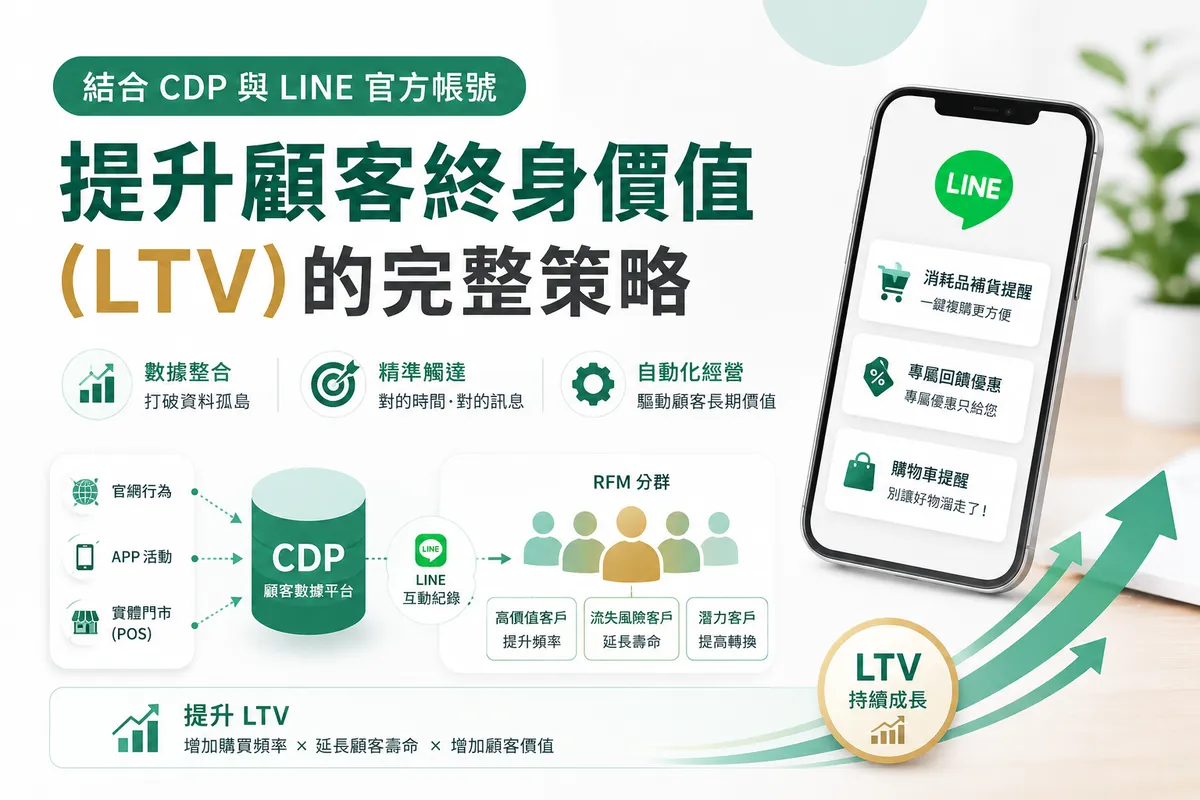
The core function of a customer data platform (CDP) is to break down data silos, unifying behavioral data from the website, mobile app, in-store POS systems and LINE Official Account into a Single Customer View.
Data cleansing and RFM segmentation
A CDP runs an RFM model based on each customer’s Recency (most recent purchase), Frequency and Monetary value. Using preset logic, the system classifies customers automatically, for example flagging high-spending customers who haven’t bought in 90 days as “high-value customers at risk of churn.”
Dynamic tags and predictive models
Beyond transaction history, a CDP captures customers’ browsing paths on the website and time spent on product pages, and builds preference tags automatically. When a customer’s behavior meets a set threshold, the system triggers the matching conversion flow.
Using a LINE Official Account as a precision engagement channel
LINE has high reach and high open rates in Taiwan, making it well suited for personalized push messages and membership cards. The built-in LINE back office alone can’t handle complex cross-channel data, so it must be connected to a CDP through an API.
Identity Resolution
After customers add the LINE Official Account, they link their membership through the rich menu (Bind Account). This step connects their LINE UID with the email or mobile number in the CDP, so the company can see that LINE account’s purchase history in physical stores and on the e-commerce website.
Trigger-based automated messages
Untargeted broadcasts to everyone tend to get blocked. Once connected to a CDP, messages are driven by data events instead:
- Replenishment reminders for consumables: The CDP calculates the average usage cycle of specific skincare products or health supplements and, on day 25, automatically sends a one-tap reorder link via LINE, increasing average purchase frequency.
- Reactivating dormant customers: When RFM segmentation shows a customer entering the churn-risk period, the CDP triggers LINE to send an exclusive repurchase coupon, extending average customer lifespan.
- Abandoned cart reminders: When a customer adds items to their cart on the website but doesn’t check out, the system sends a LINE push reminder 2 hours later, raising the conversion rate of individual transactions.
Benefits and prerequisites
Combining a CDP with LINE reduces the cost of untargeted push messages and increases each customer’s contribution.
This approach does depend on certain conditions. First, the company needs a sufficient base of data; if monthly transaction volume is too low, the benefits of the CDP’s machine learning and automated segmentation will be limited. Second, LINE Official Account API messages carry a per-message cost, so marketing teams must calculate whether the marginal profit from each automated push exceeds the messaging fee, and avoid contacting customers so often that it erodes margins.
Companies should set up data metrics with a regular calibration process and fine-tune the CDP’s automated trigger logic based on actual results, so that every interaction matches the customer’s current needs.
AIM from ESi Technology is an all-in-one LINE marketing platform. It offers solutions for running an engaging LINE account, shows you who your LINE friends are, and adds in-depth data analysis, so you can gain friends more efficiently, avoid blocks, and turn friends into paying customers.
By providing comprehensive, real-time, personalized data, a CDP helps businesses adapt to the digital environment, improve efficiency, customer experience and competitiveness, and drive digital transformation.
Want to learn more about customer data platforms (CDP) and how to get started? Visit our site for more: Customer data platform (CDP)
Open up new channels for growth
See your members in full and build momentum for revenue growth.
Further reading:
- The 80/20 rule of membership: how to keep your most valuable customers
- What is a customer data platform (CDP), and how does it help businesses and marketers?
- How to market with a LINE Official Account: 8 principles for member engagement and conversion on LINE
Share this article
- Share “From Acquisition to Retention: How CDP × LINE Grows Customer Lifetime Value” on Facebook (opens in a new window)
- Share “From Acquisition to Retention: How CDP × LINE Grows Customer Lifetime Value” on LINE (opens in a new window)
- Share “From Acquisition to Retention: How CDP × LINE Grows Customer Lifetime Value” on LinkedIn (opens in a new window)