Digital marketing
AIM LINE Marketing: Precise Member Segmentation for Retail Repeat Sales
- LINE
- Digital transformation

Contents
- Scattered member data keeps precise marketing out of reach
- Start from member tags to build a more precise segmentation strategy
- Implement a CDP to move member segmentation from manual work to automation
- A retail scenario: from in-store purchase to precise repeat sales on LINE
- Make LINE a member management tool, not just a promotion channel
For retail brands, a LINE Official Account has long been a key channel for talking to members. Yet as the friend count keeps growing, repeat purchases don’t necessarily grow with it. Broadcast to everyone when a new product launches, send coupons for every holiday, step up promotions when sales dip: it looks like steady member engagement, but it can miss a crucial question: if different members have different needs, why should they all get the same marketing message?
Truly effective LINE marketing isn’t about sending more messages. It’s about understanding each member’s purchase status and behavior, and delivering relevant content at the right moment.
Scattered member data keeps precise marketing out of reach
Many retail brands run physical stores, a brand website, e-commerce platforms and a LINE Official Account at the same time. Each channel builds up a lot of data, but it may be scattered across POS, CRM, e-commerce back ends and different marketing tools.
For example, one customer bought skincare products in a store last week, yet this week receives a first-purchase discount for the very same product. Another customer hasn’t bought anything in six months, but the brand keeps sending new-product news without any win-back campaign designed for that churn risk.
Without a way to unify member data and analyze purchase behavior, marketers can only broadcast the same message to everyone, so every push message drives more blocks.
When a brand has to compile lists by hand, set tags manually, or simply broadcast to everyone who is a friend, it is hard to keep up with changes in member spending, and harder still to build a sustained member management strategy.
At the same time, brands should manage message frequency, member consent status and opt-out settings, to avoid the backlash that comes from over-communicating.
Start from member tags to build a more precise segmentation strategy
The first step to better LINE marketing results is building a member segmentation framework that supports marketing decisions.
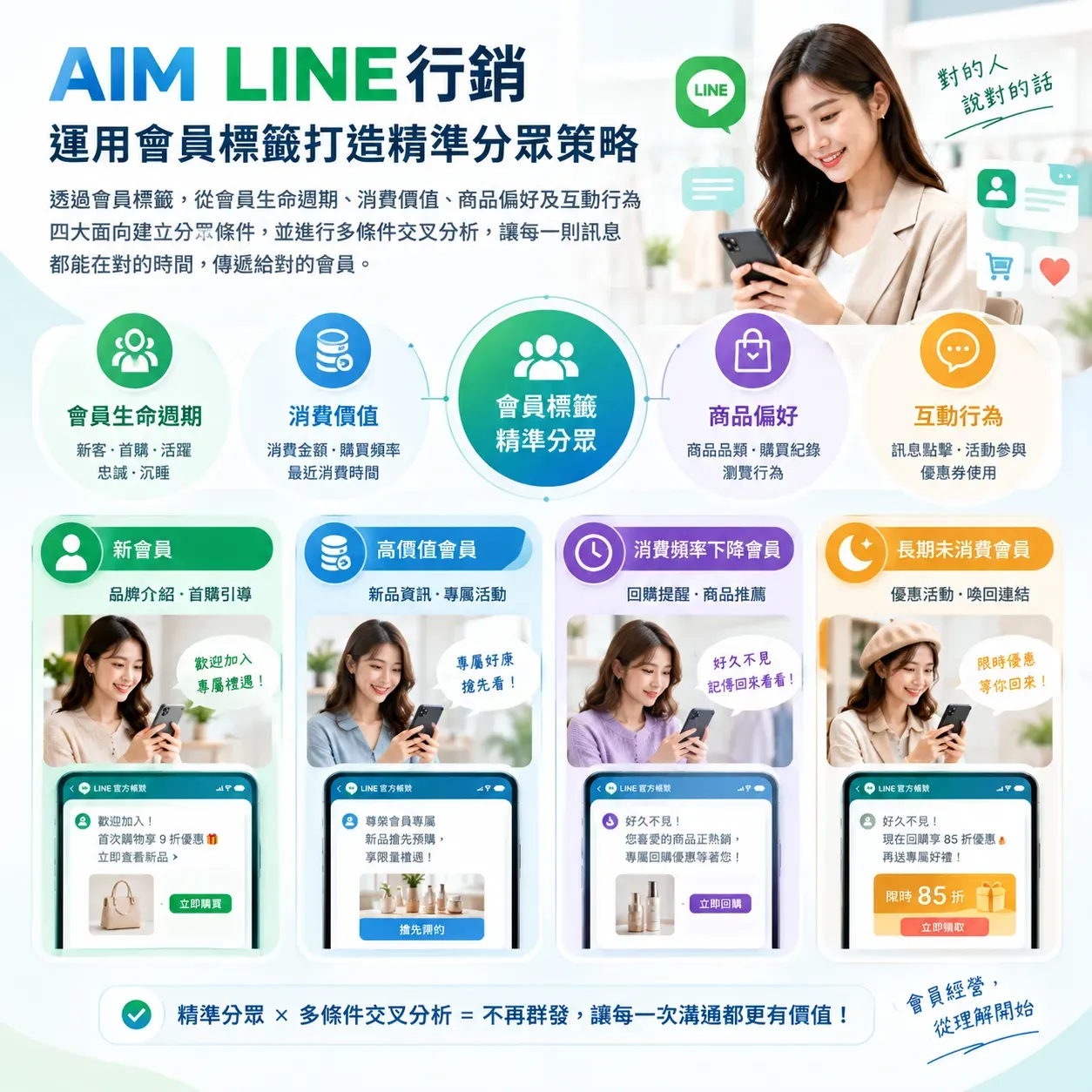
Businesses can start from these four dimensions:
1. Member lifecycle: identify the needs of each stage
Using sign-up date, first purchase date, most recent purchase and repeat purchase history, divide members into new members, first-time buyers, active members, loyal members and dormant members. New members need to get to know the brand, first-time buyers need to build trust, and dormant members need a fresh reason to buy.
2. Customer value: set different priorities
Based on spend, purchase frequency and time since last purchase, identify high-value members, steady repeat buyers and members whose spending is declining. Brands can offer high-value members early access to new products, and design dedicated repeat-purchase incentives for members who are buying less often.
3. Product preferences: make recommendations more relevant
Combine product categories, purchase history and any available browsing or engagement behavior to analyze member preferences. For example, members who often buy mother-and-baby products can receive product information that fits their child’s stage, while customers who prefer a particular apparel category can be first to hear about related new arrivals and styling recommendations.
4. Engagement behavior: gauge how willing members are to respond
Track whether members click campaign messages, take part in brand activities, use coupons or complete specified interactions, and use this to adjust content and frequency. Note that clicks or engagement are not actual purchases; marketing performance should still be judged together with transaction data.
By cross-combining multiple criteria, brands can move beyond simple member categories to segmentation strategies with real business value.
This is the core value of combining a CDP with LINE marketing: turning member data into a management strategy you can run, track and optimize continuously.
Implement a CDP to move member segmentation from manual work to automation
As membership keeps growing, maintaining tags and lists by hand leads to delayed updates, criteria that are hard to manage, and duplicated work.
The value of a customer data platform (CDP) is that it helps businesses unify member data from different sources, build a consistent foundation for member identification and segmentation, and then put the organized data to work in marketing campaigns.
Take AIM CDP with LINE marketing as an example. Depending on the data sources actually connected and the system features available, brands can plan different member management scenarios:
- New member onboarding: For members who have just joined the LINE Official Account, schedule a brand introduction, popular product recommendations and first-purchase guidance.
- Repurchase reminders: Select members who should receive reminders based on product characteristics and past purchase cycles.
- Dormant member win-back: Find members who haven’t purchased for some time and test different comeback offers and messages.
- High-value member retention: Design member-exclusive activities and relationship-building mechanisms based on spending contribution and engagement.
Once member criteria, message content and trigger rules are set up properly, the system can help run parts of the member management workflow. Marketers spend less time repeatedly compiling lists and sending messages, and more time on strategy and performance optimization.
A retail scenario: from in-store purchase to precise repeat sales on LINE
Take an apparel brand that runs physical stores, a brand website and a LINE Official Account. Suppose the brand wants to raise its member repurchase rate. In the past, it could only broadcast new arrivals or discounts on a regular schedule, with no way of telling which members actually needed them.
By using a CDP to unify the member data and purchase records available, the brand can design a concrete member journey.
Step 1: Unify member data and build purchase profiles.
When customers complete a purchase in store or on the website, the brand can use its existing POS, e-commerce system and member data integrations to combine transaction records with identifiable member data, then match this with member identification from the LINE Official Account to build a more complete purchase profile. This assumes each system can be integrated and that member data can be identified and used lawfully.
Step 2: Segment by purchase behavior.
Using time since last purchase, purchase frequency, product categories and historical spend, the brand can divide members into recent buyers, likely repeat buyers and long-term inactive members. For example, customers who just bought new fall arrivals don’t necessarily need a discount on the same items right away, while members who haven’t purchased for a while may respond better to new-product recommendations or repurchase offers.
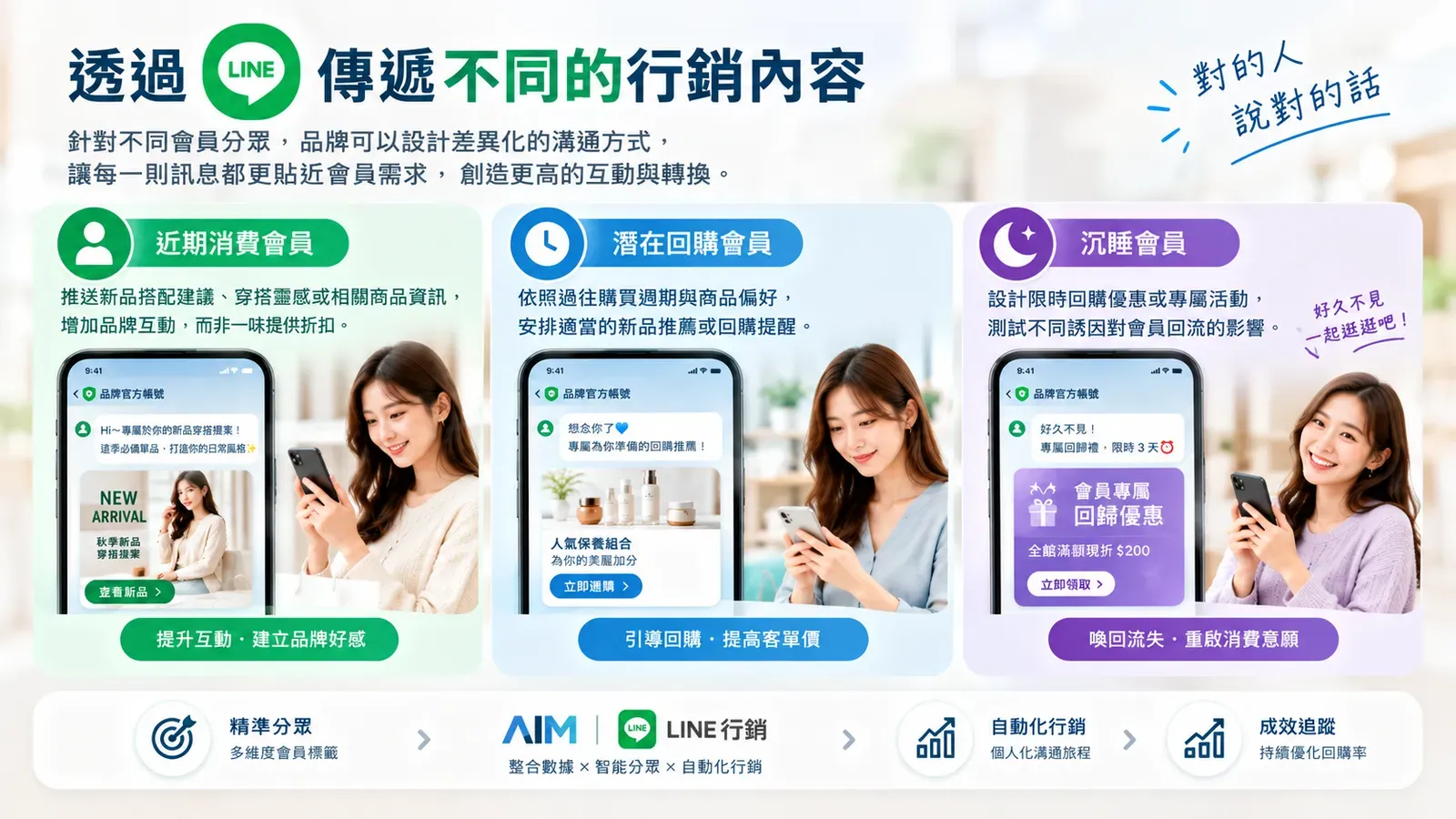
Step 3: Deliver different marketing content through LINE.
For each member segment, the brand can design a different approach:
- Recent buyers: Send styling suggestions, outfit inspiration or related product information to build engagement, rather than simply offering discounts.
- Likely repeat buyers: Schedule well-timed new-product recommendations or repurchase reminders based on past purchase cycles and product preferences.
- Dormant members: Design limited-time repurchase offers or exclusive activities, and test how different incentives affect members’ return.
If AIM’s data criteria, LINE integration and automation features support the required settings, the brand can run its marketing workflows based on member segment criteria and preset rules, reducing the burden of compiling lists by hand and sending messages batch by batch.
Step 4: Track results and keep optimizing the member journey.
After a campaign goes out, the brand shouldn’t look only at delivery or clicks. It should also check whether members come back to buy on the website or in store, whether campaign conversion rates improve, and how repurchase performance differs across segments.
For example, the brand can compare the conversion of different repurchase messages, or set up a proper control group to determine whether a promotion actually generates additional orders. Measuring repurchases in physical stores requires trackable member identification, transaction data feedback or campaign attribution.
This way, LINE is no longer just a channel for promotional messages, but a management tool linked to member data, purchase behavior and performance analysis.
True precision marketing isn’t about sending every member more messages. It’s about giving each member content that better fits their needs, at the right moment.
Make LINE a member management tool, not just a promotion channel
For retail brands with online and offline channels, the value of member data lies not in how many records you collect, but in whether they turn into better business actions.
By using a CDP to unify member data, build precise segments, and combine LINE marketing with automated journeys, businesses can gradually move from mass broadcasts to communication based on member needs, improving the member experience and grounding marketing investment in evidence.
When a brand truly understands each member, it doesn’t have to say the same thing to everyone. It can deliver messages more worth responding to, at the right time.
ESi AIM is an all-in-one LINE marketing platform. It offers lively solutions for running LINE and a clear picture of your friends, backed by in-depth data analysis, so you can grow friends more efficiently, avoid blocks and convert friends into real customers.
By providing comprehensive, real-time and personalized data, a CDP helps businesses adapt to the digital environment, improve operational efficiency, customer experience and competitiveness, and drive digital transformation.
Want more information about customer data platforms (CDPs) and how to get started? Visit our website now to learn more: CDP customer data platform
Open up your marketing growth channels
See your members in full and drive revenue growth
Further reading:
- The 80/20 rule of member management: how to keep your most valuable customers
- What is a customer data platform (CDP)? How does a CDP help businesses and marketers?
- LINE Official Account marketing: 8 ways to engage members and convert
Share this article
- Share “AIM LINE Marketing: Precise Member Segmentation for Retail Repeat Sales” on Facebook (opens in a new window)
- Share “AIM LINE Marketing: Precise Member Segmentation for Retail Repeat Sales” on LINE (opens in a new window)
- Share “AIM LINE Marketing: Precise Member Segmentation for Retail Repeat Sales” on LinkedIn (opens in a new window)