Digital marketing
An Introduction to the Gartner DXP Magic Quadrant
- Adobe Experience Cloud
- Sitecore
- Digital transformation

The DXP (digital experience platform) is an emerging concept. As MarTech evolves rapidly, many different solutions must be integrated and work together to give customers a complete and consistent digital experience. That is why, over the past two years, Gartner introduced DXP as a new Magic Quadrant to help companies evaluate platforms when buying.
Vendors offering these solutions are still exploring what is possible, and both product capabilities and implementation methodologies are evolving quickly. Generally speaking, DXP solutions today still have plenty of room to improve.
Even though DXP is a new category, quite a few vendors qualified for evaluation. In 2020, 14 vendors had their DXP solutions evaluated. The main reason is that, although DXP has only just been defined, MarTech vendors have been building DXP-related integration features into their platforms over time in response to enterprise demand. As a result, most software vendors with portal or WCM (web content management) solutions have a solid foundation for developing new DXP platforms.
DXP: the digital experience platform
By definition, a digital experience platform is a fully integrated suite that supports content authoring, management and delivery, and optimizes the content experience. A DXP’s focus is delivering a consistent experience across touchpoints and channels along the customer journey, so “integration” is its most important characteristic.
For enterprise clients, implementing a DXP means making it the central hub for managing the entire digital experience. All complex experience management and integration of new technologies fall within the scope of the DXP. So rather than thinking only about common touchpoints such as the website, e-commerce or apps, companies should plan the experience and interaction at every touchpoint based on the complete customer journey.
Because a DXP must handle a high level of digital complexity, bringing in artificial intelligence (AI) and machine learning (ML) to optimize the visitor experience is a focus of future DXP development. IoT (Internet of Things), VR/AR and wearable devices will also be key areas for DXP integration.
Gartner scores DXPs along three main dimensions:
- User experience
- Content interaction capabilities
- Search, navigation and findability
- Collaborative content production
- Knowledge management features
- Experience customization
- Digital commerce features
- DXP management capabilities
- Content management features
- Integration and organization features
- Personalization (one-to-one experiences)
- Usage analytics and optimization
- Access control
- Workflow integration and management
- Custom development
- System architecture
- Multichannel integration and content delivery
- Customer data management (CDP)
- Cloud scalability
- Global deployment and multilingual support
Based on these criteria, Gartner produced the following 2020 DXP Magic Quadrant.
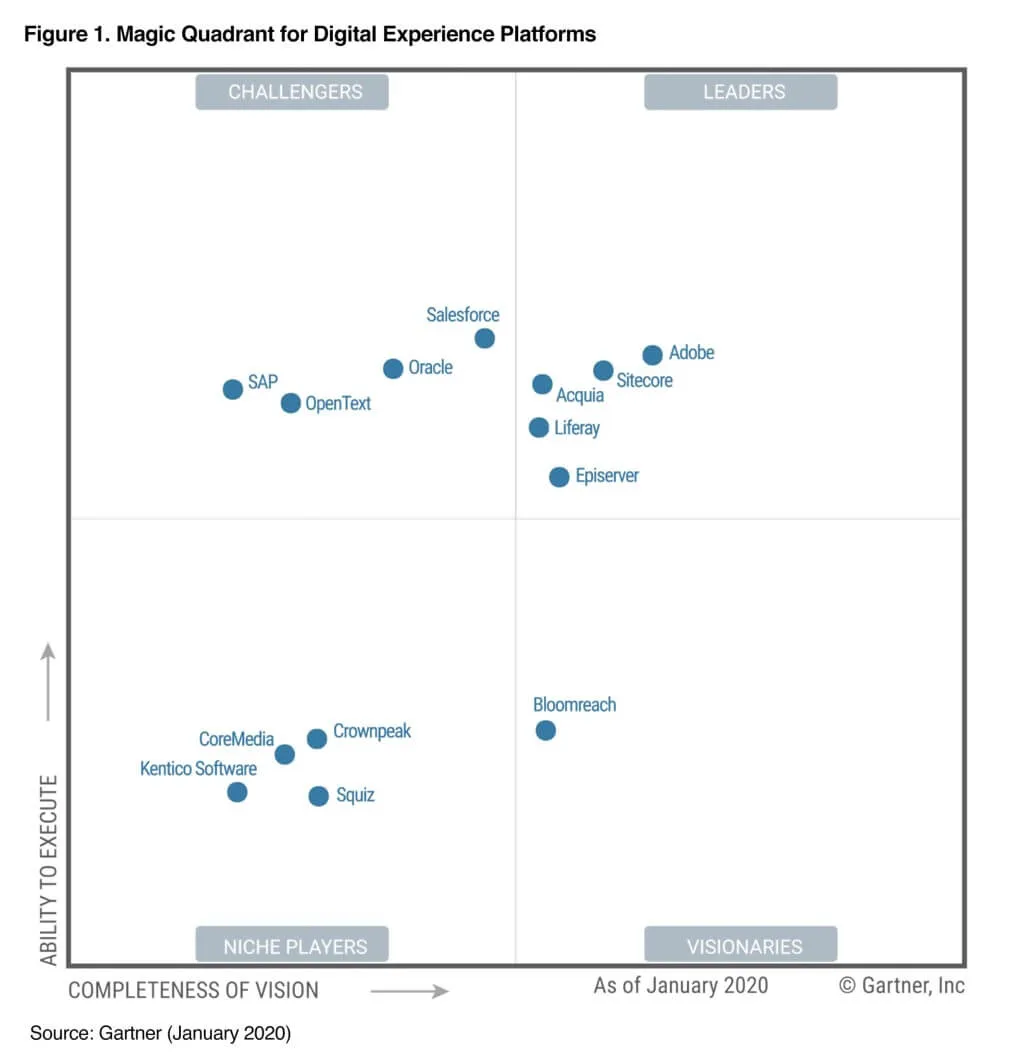
The chart shows that the leading solutions mirror Gartner’s earlier WCM evaluations, with Adobe and Sitecore as the top two. ESi has many years of implementation experience on both platforms and can help companies implement a DXP reliably and effectively to meet their digital transformation needs, ensuring a strong ROI and creating value for the business.