Software updates
Customer Retention for Retail Brands: CDP, Membership and Repeat Purchases
- CDP
- LINE
- Digital transformation
Contents
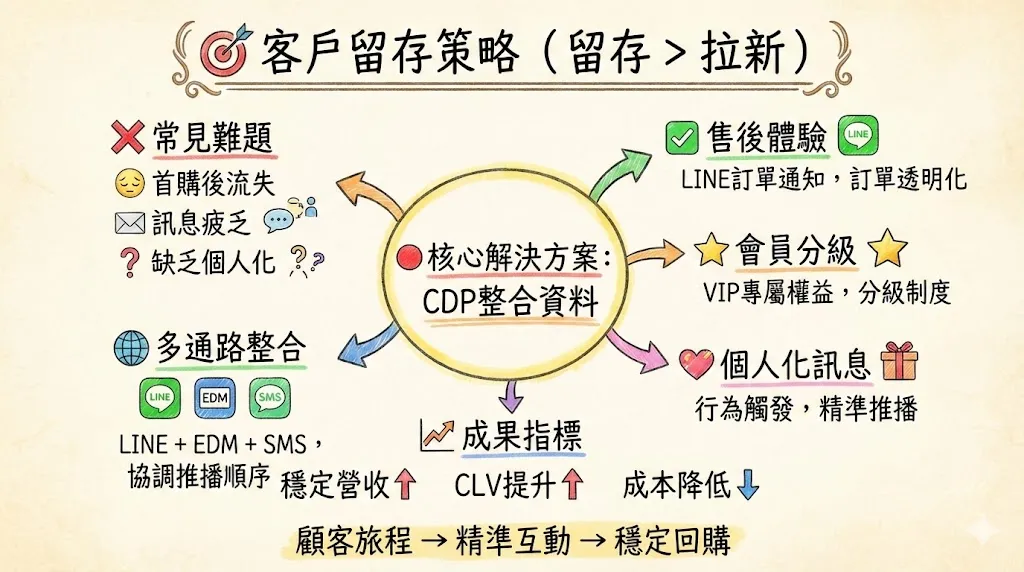
- Common member retention challenges
- Practical ways to improve member retention
- Why a CDP? Member retention rests on “data integration”
- The core problems aCDP solves:
- How retention changes after clients implement a CDP
- In practice, focus on “the reasons customers come back”
- Retention is not a one-off project but part of how a brand runs
Are your ad costs climbing, traffic getting pricier, and new customers not necessarily coming back? Whether you are in retail, health supplements, beauty, food and beverage, or subscription services, relying on acquisition alone to sustain revenue is no longer realistic.
A customer retention strategy lets every ad dollar generate revenue over a longer period. This is not just about CRM; it is the core of a brand’s growth model.
Over the past few years, more and more Taiwanese brands have made a CDP (customer data platform) the foundation of their retention strategy. The reason is simple: without unified data, it is hard to segment, predict or personalize, and even harder to launch automated customer care.
Common member retention challenges
Without a unified view of the customer, teams can only “guess” what customers will do next, and retention is hard to improve.
Do any of these scenarios sound familiar?
- Customers go quiet after their first purchase.
With no behavioral data and no clear repurchase rhythm, it is hard to tell where you are losing them. - Lots of messages, few orders.
You send LINE messages, EDMs and SMS, but the content is similar and unsegmented, so customers tune it out. - Plenty of campaigns, but customers don’t remember the brand.
There are promotions every week, but little personalized interaction or exclusive value. - The membership program is incomplete.
Points, tiers and birthday gifts all look to be in place, but they aren’t connected to data, and the automation is patchy.
Practical ways to improve member retention
1.Make after-sales hassle-free
Taiwanese consumers care about after-sales service, speed and transparency.
For example:
- Order confirmations and shipping alerts on LINE
- An order-tracking page available 24 hours a day
- A clear returns and exchanges process
When customers feel they can “reach someone and find out what’s happening,” trust grows and so does their willingness to buy again.
2.Membership tiers are not a rulebook but “what customers expect”
When Taiwanese brands design tiers, the most successful models are the ones whose benefits members “feel in everyday life,” for example:
- A supplement brand’s “regular repurchase discount”
- A beauty brand’s “VIP gift plus new-product pre-orders”
- A retail brand’s “members’ day discount”
Tiers shouldn’t sit on an information page of your website; they should come up “naturally” through well-timed messages. Most of these touchpoints are triggered by a CDP, based on repurchase cycles, changes in order value, browsing behavior and more.
3.Drive repeat purchases with personalized messages
Taiwanese users respond poorly to messages that are “too broad and too salesy.”
But when the content relates to what they have done recently, results are noticeably different.
For example:
- 25 days after buying a supplement, they get a “time to restock” reminder with a member price
- In their birthday month, members receive an “exclusive new-product treat”
- Someone who often browses a category gets a “top 5 bestsellers in this category” list
All of these rely on a CDP to match data and trigger automation; doing them manually is very hard.
4.Coordinate LINE, EDM and SMS so messages arrive in a clear order
Omnichannel doesn’t mean “send all three”; it means “make all three work together.”
A CDP’s channel priority helps decide “LINE first, then follow up with EDM or SMS,” avoiding over-messaging and improving the results of every message.
Why a CDP? Member retention rests on “data integration”
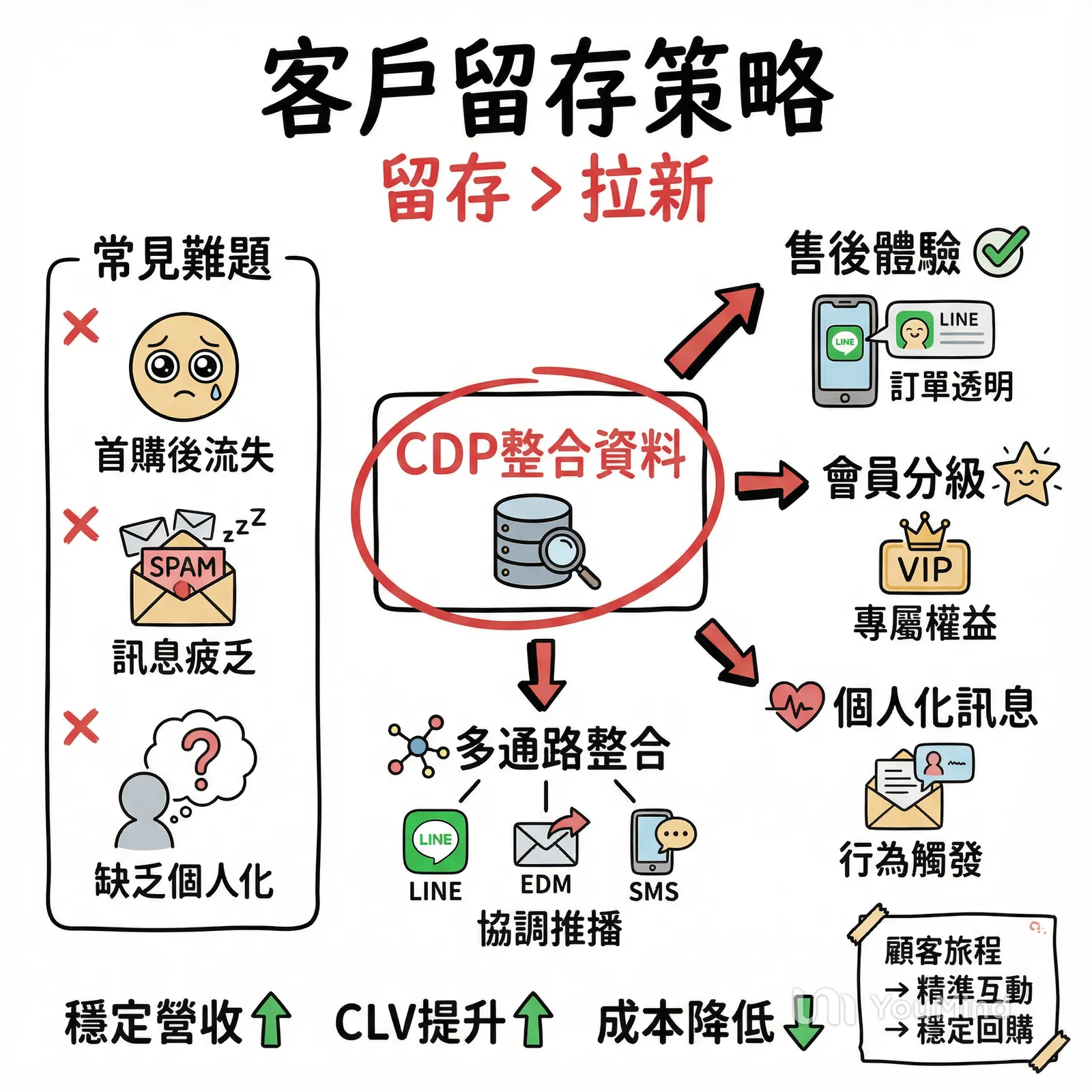
Most brands do work on retention. What they lack is a tool to unify their data, so their retention tactics can’t be automated.
The core problems aCDP solves:
- A clear customer profile
Purchases, browsing, clicks, email opens, repeat purchases and frequently bought items all come together in one complete member journey. - More precise segmentation and prediction
For example:- Customers who haven’t repurchased in 30 days but used to buy on a regular cycle
- Customers who browse often but haven’t added anything to their cart
- Customers who buy only discounted items but still spend a fair amount per order
Once you have segments, you can launch different retention mechanisms for each.
- Cross-channel automation
LINE, EDM and SMS push messages can all be sent automatically based on behavior, without manually setting up every message. - Higher CLV (customer lifetime value) per customer
Clear journey → targeted engagement → steady repeat purchases
This is a cycle you can measure.
How retention changes after clients implement a CDP
Most apparel retailers know the pattern: traffic is high when new collections launch, but footfall becomes unpredictable once the season ends. Ads can win that first conversion without much trouble, but bringing customers back to the store or website takes more work. The market is crowded, choices are plentiful and new styles arrive quickly, so promotions alone can hardly sustain repeat purchases.
That is why retention optimization matters. Its purpose is not to prop up promotions but to turn a “first purchase” into an “ongoing choice.”
It is also why many apparel brands have invested in a CDP (customer data platform) in recent years: retention starts with unified data and an understanding of behavior.
In practice, focus on “the reasons customers come back”
1.Remember each customer’s style preferences
Repeat purchases in fashion depend heavily on “consistency of style.” If a brand uses a CDP to record:
- Categories customers often buy (dresses, jackets, shirts)
- The sizes they usually choose
- The discount levels they respond to
- Items they often browse but haven’t bought
then the next push message can match each customer’s preferences, instead of every member receiving the same content. More personal messages like these usually earn higher engagement.
2.New arrivals work best when they’re “targeted,” not just fast
Taiwanese apparel brands launch new products often, but sending every launch to every member causes fatigue. Segmenting with a CDP makes new-arrival messages feel more like “a thoughtful heads-up”:
- Members who often buy maxi dresses get the new maxi dresses
- Members with a consistent size get “new arrivals available in your size”
- People who only buy on sale get “this week’s deals”
This makes customers feel understood far more than an “everything new” blast.
3.Store and online data must be unified
A typical apparel pattern: customers browse styles online and try them on in store, or buy in store and later order on the website. If the data isn’t connected, you can’t see:
- Everything the customer has bought
- The styles they prefer this season
- Their repurchase rhythm across both channels
A CDP brings together behavior from POS, website, LINE and app, so the brand truly knows the purchase history of “the same person” instead of a scattering of separate records.
4. Drive repeat purchases around the change of seasons
Seasons turn quickly in apparel retail, and each change of season is a key moment for repeat purchases. With CDP behavioral data, you can automatically send messages at these moments:
- A change-of-season reminder the season after someone buys a jacket
- Styling suggestions after someone buys a skirt or dress
- New outfit inspiration timed to each customer’s purchase cycle
Content like this brings customers back more naturally than broad promotions.
Apparel brands grow by “giving customers a reason to come back”
However trends change, customers are looking for “a brand that gets their taste.”
If you use data to understand each customer’s style, rhythm and needs, and deliver information the right way, repeat purchases follow naturally.
Retention is not a one-off project but part of how a brand runs
For retail brands, marketing campaigns alone rarely build a membership base with “steady repeat purchases.”
To build a growth model that is predictable, repeatable and scalable, retention has to become a system that runs continuously, and a CDP is the core of that system.
When customer data can be unified, segmented and used to trigger automation, retention naturally improves.
Over the long term, this shows up as:
- More stable revenue
- A higher share of loyal customers
- More efficient marketing spend
If you manage a membership program, a CDP is the best starting point for keeping your retention engine running.
AIM from ESi Technology is an all-in-one LINE marketing platform. It offers solutions for running an engaging LINE account, shows you who your LINE friends are, and adds in-depth data analysis, so you can gain friends more efficiently, avoid blocks, and turn friends into paying customers.
By providing comprehensive, real-time, personalized data, a CDP helps businesses adapt to the digital environment, improve efficiency, customer experience and competitiveness, and drive digital transformation.
Want to learn more about customer data platforms (CDP) and how to get started? Visit our site for more: Customer data platform (CDP)
Open up new channels for growth
See your members in full and build momentum for revenue growth.
Further reading:
- The 80/20 rule of membership: how to keep your most valuable customers
- What is a customer data platform (CDP), and how does it help businesses and marketers?
- How to market with a LINE Official Account: 8 principles for member engagement and conversion on LINE
Share this article
- Share “Customer Retention for Retail Brands: CDP, Membership and Repeat Purchases” on Facebook (opens in a new window)
- Share “Customer Retention for Retail Brands: CDP, Membership and Repeat Purchases” on LINE (opens in a new window)
- Share “Customer Retention for Retail Brands: CDP, Membership and Repeat Purchases” on LinkedIn (opens in a new window)